
 By
By 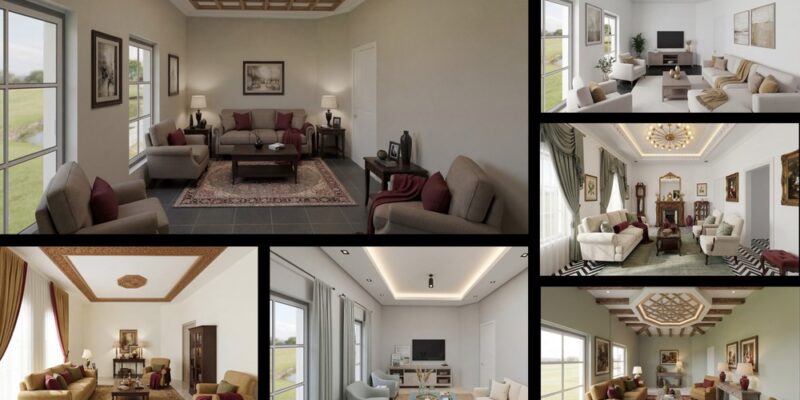
The 3-5-7 rule is a simple interior design principle: group objects in sets of three, five, or seven to create compositions that feel balanced, intentional, and visually engaging. It sounds almost too basic, until you pair it with AI tools like Foursite by VirtualSpaces that can turn 2D floor plans and blueprints into immersive 3D visualization and photoreal interior design renders in minutes. For residential interior designers, that pairing is where the business model starts to shift.
What Is the 3-5-7 Rule in Interior Design?
At its core, the 3-5-7 rule (sometimes called the “rule of odd numbers”) says that décor and styling elements look more natural when grouped in odd-numbered sets, three, five, or seven, rather than in rigid even pairs. Our brains read these odd clusters as more organic and less staged, making a console, coffee table, or shelf instantly more interesting without adding more stuff.
Designers use the rule at multiple scales: three main focal pieces in a living room, five key materials across a palette, seven small décor items to tell a story on a bookshelf, a flexible framework that helps avoid visual clutter while layering richness and personality into real homes.
Where Designers Lose Time and Margin Today
Most residential interior designers know the creative answer long before the software catches up. The real friction sits in the pipeline: 2D floor plans arrive as PDFs or skewed scans, rebuilt in CAD, extruded to 3D in another tool, then handed off to a visualization studio for renders. Every client change triggers another round of re-exports and outsourced revisions.
Many studios are still running “CAD-first” pipelines designed for an era before AI 3D visualization was possible at consumer hardware levels. The result: slow turnarounds, squeezed margins, and a creative process constantly waiting on someone else’s render queue.
Foursite: From 2D to 3D in a Single Pipeline
Foursite is built to collapse that entire chain for residential projects. Designers upload 2D floor plans or blueprints, and the platform automatically converts floor plan to 3D and blueprint to 3D, parsing walls, doors, and windows to build a navigable 3D shell requiring no traditional CAD or 3D skills.
From there, designers can apply AI interior design and AI interior décor presets to generate full room schemes, use AI virtual staging to furnish empty rooms digitally, and produce interior design renders and photoreal renders from any viewpoint, all inside one 3D visualization environment. That alone eliminates the outsourcing costs that have long burdened residential studios.
Foursite generates multiple options for the same floor plan in minutes
How AI Makes the 3-5-7 Rule Actionable at Scale
On its own, the 3-5-7 rule is a mental model. In Foursite, it becomes a rapid experimentation engine. For a standard living room, designers upload the client’s 2D floor plans, the system runs 2D to 3D conversion, and they select a base layout using AI interior design: sofa, rug, media unit, and signature art as their “3.” They then layer in AI interior décor and virtual staging variations to test five medium-scale elements and finish with seven small styling details.
Because Foursite generates interior design 3D visualization and photoreal renders in minutes, designers can show two or three fully resolved 3-5-7 compositions side by side, same shell, same budget, but different stories about how the client might live there. The rule acts as a constraint that keeps options legible and human; the AI acts as a multiplier that lets you explore those options without burning days of manual modeling.
Faster Turnarounds, Higher Effective Revenue
When designers convert floor plan to 3D in a single environment, they reduce billable hours spent on low-leverage drafting, free senior designers to stay in “editor mode” instead of “production mode,” and increase the number of residential projects they can run in parallel, because renders no longer block decisions. The result is a higher effective hourly rate without raising fees: the same project scope, but less time fighting files and more time exercising the judgment clients are actually paying for.
Bringing It All Together
Used alone, the 3-5-7 rule is a helpful styling trick. Used inside an AI-first workflow powered by Foursite and VirtualSpaces, it becomes part of a larger operating system for residential design, one where blueprints and 2D floor plans flow through a 2D to 3D pipeline into AI virtual staging, AI interior design, and AI interior décor, and out the other side as interior design renders and photoreal visualizations ready to close clients and drive revenue. The designers who will thrive in that world are not the ones who fear AI, but the ones who treat it as a collaborator: fast, tireless, and happy to explore every 3-5-7 combination imaginable so you can stay focused on the one thing no algorithm can fake yet, taste.



Comments